
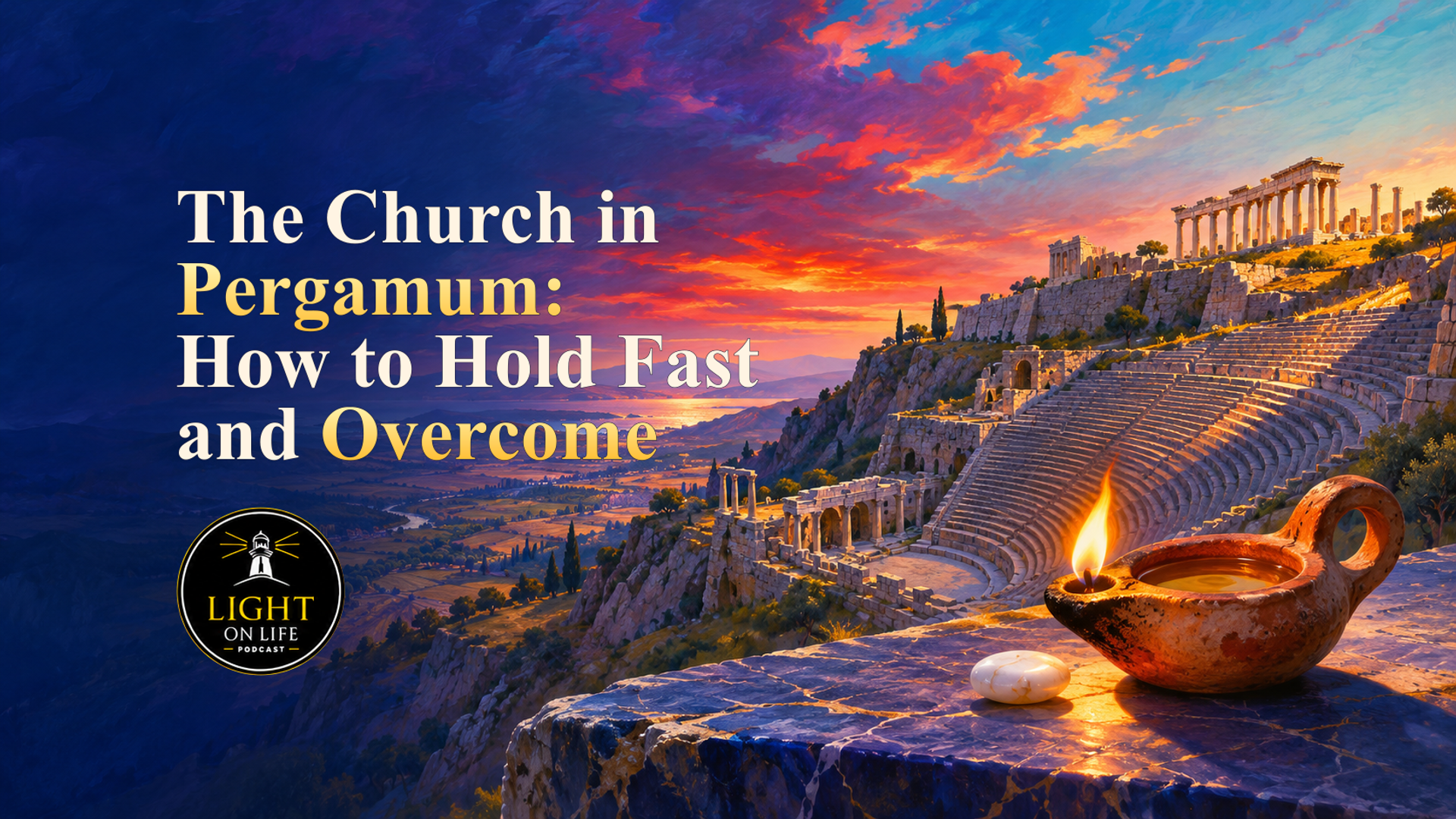
Podcast cover art for “The Church in Pergamum: How to Hold Fast and Overcome,” featuring the ancient ruins and amphitheater of Pergamum beneath a dramatic sunset. A glowing oil lamp rests on a stone ledge in the foreground, symbolizing faith and perseverance. The Light on Life Podcast logo appears beneath the title.
Standing your ground is one thing when everybody agrees with you. But what happens when holding fast to Jesus puts you at odds with the people around you? What happens when refusing to compromise costs you something? That's exactly the kind of pressure the Jesus followers at Pergamos faced. They lived where Satan's throne was, surrounded by idolatry, emperor worship, and demands to conform. Jesus commended them for holding fast to His name. But there was a problem. Some among them were holding fast to something else—false doctrine that opened the door to compromise. So how do you stand your ground when the pressure is on? And what if you've already compromised? That's where we're going today in Revelation chapter two. So grab your Bible, and let's dive into The Church in Pergamum: How to Hold Fast and Overcome—that's our focus on this weeks Light On Life.
Listen to the Audio
This Week: Discover how to hold fast to Jesus, refuse compromise, and respond to His call to repentance in Revelation 2:12–17.
#S13-046
Never Miss an Episode
Join believers who are growing in God’s Word every week. Subscribe to the Light on Life Podcast on your favorite platform:
Use this if your podcast app supports adding shows by RSS feed.
Accept the Challenge
Hold Fast. Refuse Compromise. Overcome.
Hebrews 4:14 (KJV) — Seeing then that we have a great high priest, that is passed into the heavens, Jesus the Son of God, let us hold fast our profession.
Here's your challenge this week.
Identify one area where you've been pressured to compromise your convictions.
Ask yourself, "What does Jesus say about this?"
Then make the decision to stand on His Word, regardless of what others are doing.
Remember: Don't let yesterday's compromise become tomorrow's way of life.
Hold fast. Refuse compromise. Overcome.Join the Conversation
Each week's podcast also contains a question designed to encourage testimony. Testimony is vital to a believers life. We overcome by it (Rev. 12:11).
This week's question:
Join This Conversation
Question:
Have you ever faced pressure to compromise your
convictions because everyone around you was doing
something different?
Share:
What helped you stand your ground and hold fast
to God's Word? Or has God shown you an area where
you needed to repent and change direction?
Remember:
Your experience may encourage another Jesus
follower facing the same pressure. Share your
thoughts and join the conversation.

About Emery and Sharon
For nearly five decades, Emery has devoted his life to helping people grow in Christ through the power of the Word and the leading of the Holy Spirit.
Together with his wife, Sharon — his partner in life and ministry for 44 years — he equipped believers to live Spirit-filled, practical lives of faith.
At the heart of the mission is this: helping believers apply God's words so faith becomes active and unstoppable.
If this episode helped you, would you share it with a friend and leave a quick review?
Podcast Notes:
Well again, welcome.
Let’s pray.
Father God, we come to you right now, and we ask that you would grant unto us a spirit of wisdom and revelation in the knowledge of you. Open the eyes of our hearts today so that we might see and know you clearer. Help us also today not just to be hearers of the Word but to be doer’s as well in Jesus’ Name, we pray, Amen.
Summary — Hold Fast to Your Confession
Last time, we looked at Hebrews 4:14 and the command to hold fast to our profession of faith.
We learned that hold fast [krateō] means to cling tenaciously to Jesus and His Word, refusing to let go when opposition comes.
Colossians 2:6 reminded us that receiving Jesus as Lord and walking in Him is a package deal.
We also learned that holding firmly to Jesus produces a life that is rooted in Him.
Ephesians 3 showed us that the Holy Spirit strengthens us in our inner man so that we can be rooted and grounded in love.
When opposition comes, we don’t have to be moved off what God has said.
We have Jesus, the Holy Spirit, and the Word of God. What tremendous resources!
Believe God. Hold fast to your confession.
Now, let’s take that thought of holding fast into Revelation chapter two and see what Jesus has to say about overcoming.
Hold fast. Refuse compromise. Overcome.
Revelation 2:12: Some Bible Background on the Church at Pergamos
The words hold fast and overcome take center stage among the seven churches in Revelation.
Jesus delivered a message to these churches through John the apostle while he was imprisoned on the isle of Patmos.
Revelation 2:12–13 (KJV) — 12 And to the angel of the church in Pergamos write; These things saith he which hath the sharp sword with two edges; 13 I know thy works, and where thou dwellest, even where Satan’s seat is: and thou holdest fast my name, and hast not denied my faith, even in those days wherein Antipas was my faithful martyr, who was slain among you, where Satan dwelleth.
And with that thought, here is the Historical Background of the Day.
Revelation 2:12a: Historical Background on the City of Pergamos
Pergamos was an absolute mess of a city to live in for a Jesus’ follower.
The reason?—Oh, let me just tell you.
The occult was well established in Pergamos 400 years before a Jesus’ follower ever appeared in this city.[1.]
Pergamos was the foremost city for emperor worship.
Two temples, one to the Emperor Augustus and one to the Emperor Trajan resided there.
That means that Christians of the city were under pressure to publicly pay honor to the emperor as god.
Publicly meant openly—you couldn’t ‘fake’ your confession of the emperor by doing it behind closed doors.
No, you had to offer a sacrifice—you had to burn incense before the altar of the emperor.
You had to bow down and profess that “Caesar is Lord.”[2.]
Jesus’ followers had to choose between Jesus is Lord and the Emperor is Lord.
A refusal could be regarded as an act of high treason.
Handpicked inhabitants of Pergamos were required to participate in festivals, public meals, games, and ceremonies honoring the emperor as god.
One never knew when their ‘number would be called.’
That’s heavy-duty pressure that weighed on every citizen of this city.
You would wake up in the morning and wonder, “Would today be the day you had to show allegiance to Caesar?”
Adding to this already heavy weight of stress was a 40-foot-tall statue of Zeus that overlooked the city.
It had its temple.
Dionysus, the god of wine and partying, had a temple in Pergamos as well.
As did Athena, the goddess of wisdom and war.
False god temples were everywhere.
On any given day, a devout worshipper of one of these false gods could confront you and put you on the spot about who you were worshipping.
You were constantly looking over your shoulder.
The hospital in this city, quote unquote, was also a temple—a massive 154,000-square-foot temple to Asklepios (pronounced ass-KLEE-pee-oss).
This cult boasted that Asklepios, the serpent spirit, had the power to heal the sick.
If you went there for treatment, and lay down to sleep in one room in this temple as you underwent treatment, temple priests would let snakes out in your room.
The purveyors of this cult believed that if a snake touched you, you would be healed.[3.]
Long story short, Pergamos was a huge pagan city with tons of social pressure to conform.
And with that thought, here is the Question of the Day.
Here’s the question: ‘If you closed your eyes and placed yourself in this city, how do you think you would do? Would you hold fast to your confession?’
That’s a tough question, but it uncovers the depth of what it means to hold fast to your profession.
Here’s something else to think about in this area.
You don’t have to wait until you’re facing the pressure these Jesus’ followers faced in Pergamos.
Why not start dealing with the pressure to conform to the world’s standards right where you are?
Society is constantly changing.
New trends are an everyday reality.
Are you pressured to conform?
Now, I’m not talking about legalism here.
You know, a few years ago, the trend toward dressing casually at church became the norm.
I refused that, not because I’m being legalistic and saying, ‘Thou shalt wear a suit or a dress to church.’
But because of my conviction that this is the God of the universe who I am serving.
I mean, we dress up for dignitaries in our world.
Would you go to the White House to meet with the President of the United States in your shorts?
If you wouldn’t do that, why not dress up for the God of the universe?
Do you think that the High Priest in the Old Testament went behind the veil of the Temple where the Holy of Holies was in his shorts?
This is just my conviction—I think Jesus’ followers should dress according to a consciousness of God.
And so while others dressed down, I chose to dress up for the King of Kings and the Lord of Lords.
I’m talking about learning to stand your ground when the pressure comes to go along just to go along.
Challenge yourself not to follow the crowd.
Just because the world can doesn’t mean you should.
Learn to recognize unnecessary social pressure and resist it.
Every time you do, you’re developing the habit of standing your ground.
I’m about talking about conviction here, not just being obnoxious.
Here’s what I know: if you learn to stand your ground in the small things, you’ll be better prepared when the bigger challenges come.
Don’t wait until the pressure becomes unbearable before you learn how to hold fast.
Hold fast. Refuse compromise. Overcome.
Revelation 2:12b: The Jesus Who Speaks with the Sharpest of Swords
Let’s look at the back end of verse 12.
Revelation 2:12 (KJV) — 12 And to the angel of the church in Pergamos write; These things saith he which hath the sharp sword with two edges;
In the podcast “The Word of God Is Living and Active: 5 Incredible Truths You Need to Know,” you may recall that the Word of God is described as sharp.
Sharp meaning to cut efficiently and effectively.
It can penetrate right down into the spirit and soul of a man.
The sheer sharpness of the Word cuts through wrong thinking, wrong believing, doubt, wavering, and all unbelief like nothing else can.
It’s a word so penetrating that it cuts through the soul and reaches into the inner recesses of your heart.
Now, let’s go to verse 13, so that we can continue to build our understanding of what it means to hold fast and overcome.
The Throne of Satan
Revelation 2:13 (KJV) — 13 I know thy works, and where thou dwellest…
Again, we see the discerning power of the Word, the Lord Jesus Christ.
He knows what you are doing and the challenges you are facing in the city or place where you live.
Does God know what I am going through?—you betcha—big time He knows.
Nothing escapes His all-knowing eyes.
Let’s move on.
Revelation 2:13 (KJV) — 13… and where thou dwellest even where Satan’s seat is:
The word seat [thronos] is a translation that needs to have a 21st-century facelift.
The word means throne.
Pergamos was Satan’s throne.
Ephesians 2:2 tells us that Satan is the prince of the power of the air—the spirit that is now working in the sons of disobedience.
During the first century, Satan ruled the demons roaming on Planet Earth from the city of Pergamos.
It was literally a hell-hole of a city.
A city can’t get any darker than having the Prince of Darkness casting his shadow over it.
Do you understand?—Jesus’ followers, the light of the world, were living in this city.
Many of them didn’t even know that they were where Satan’s throne was.
They were standing tall.
They were refusing to compromise.
They were preaching the gospel, healing the sick, and declaring Jesus is Lord right under Satan’s nose.
And that’s what Jesus told this church.
Revelation 2:13 (KJV) — 13… and thou holdest fast my name, and hast not denied my faith…
Jesus, the Lord Head General of the Church, said, “You hold fast to my Name.”
And with that thought, here is the Definition of the Day.
The Greek word hold fast [krateō] is the same word used in Hebrews 4:14, where we are urged to hold fast to our confession.
Hold fast means to adhere tenaciously to or keep hold of something that belongs to you, so that it cannot be taken away.[4.]
Holding fast means holding persistently, being resolute, refusing to let go of your confession.
Why, Emery, why? Because you have an opponent who may have set up camp in your city.
And he’s not playing games, and neither should you be.
Otherwise, you wouldn’t be urged to hold on to it with tenacity.
“You hold fast my name,” Jesus said to this church, “and you have not denied my faith.”
Look at the word denied [arneomai] (pronunciation ar-NEH-oh-my)— in this context, it sends the strong message that you don’t know this person, and you are in no way related to Jesus.
That’s the choice that some of these believers in this city were facing.
‘Say you don’t know Jesus—say you’re not related to Him or else.’
And Jesus was standing and applauding these people because they hadn’t done that.
Wow—go, church, go!
Antipas: An Example of Holding Fast
Let’s go back to the Scripture.
Revelation 2:13 (KJV) — 13… and thou holdest fast my name, and hast not denied my faith, even in those days wherein Antipas was my faithful martyr, who was slain among you, where Satan dwelleth.
Who was Antipas?
I’m glad you asked.
I was going to tell you, anyway.
We don’t know a great deal about who this stalwart Jesus follower was.
Basically, there are a few things that we know from historical sources.
Ancient church tradition says that Antipas was martyred by being slowly roasted to death in a bronze kettle during the reign of Domitian.[5.]
One source says that his “crime,” according to these accounts, was that he cast out demons through prayer—demons that were prized and worshiped by the pagan people of Pergamum.[6.]
Another source says that his martyrdom was the price he paid for refusing to worship the emperor.[7.]
Whatever you subscribe to as far as the historical record is concerned, one thing we know for sure—he was a faithful witness, which is the same title given to Jesus.
Revelation 1:5 (NASB 2020) — 5 and from Jesus Christ, the faithful witness, the firstborn of the dead, and the ruler of the kings of the earth. To Him who loves us and released us from our sins by His blood—
Jesus Christ is THE faithful witness—Antipas was A faithful witness of the same class.
What a wonderful thing to be classed with Jesus.
Antipas was absolutely an example of what it means to hold fast your confession of faith.
Now, one side-note while we are here: take note that Revelation 2:13 begins and ends with the idea of dwelling.
Catch it now.
Revelation 2:13 (KJV) — 13 I know thy works, and where thou dwellest, even where Satan’s seat is: and thou holdest fast my name, and hast not denied my faith, even in those days wherein Antipas was my faithful martyr, who was slain among you, where Satan dwelleth.
So, God knows where both you and the enemy dwell, and His command to you is “Hold fast and don’t compromise.”
The Doctrine of Balaam and the Nicolaitans
Now, if all that we had to go on for the Church at Pergamos was verses twelve and thirteen, we would have to say that is an outstanding group of Jesus’ followers.
That is until you read verses fourteen and fifteen.
Revelation 2:14 (KJV) — 14 But I have a few things against thee, because thou hast there them that hold the doctrine of Balaam, who taught Balac to cast a stumblingblock before the children of Israel, to eat things sacrificed unto idols, and to commit fornication. 15 So hast thou also them that hold the doctrine of the Nicolaitans, which thing I hate.
Jesus says to this church, “I have a few things against you…”
A few things are a relatively small number of things.
It could be tempting to think that just a few things in my life being out of sync with God indicate that I’m doing okay.
But the standard for compromise is smaller than a jot or a tittle of God’s Word.
Matthew 5:18 (NASB 2020) — 18 For truly I say to you, until heaven and earth pass away, not the smallest letter or stroke of a letter shall pass from the Law, until all is accomplished!
To put this in terms we’re familiar with, a jot would be like the Greek letter iota or i, and a tittle would be like the dot on the i.
That’s a fancy way of saying that the standard for compromise is zero.
Again, Jesus said, “I have a few things against you…”
The Greek word against [kata] means down.
Jesus is saying, “I’m ‘down on’ this compromise you are exhibiting.”
For a more formal definition—Jesus is saying, “I have a grudge against you.”
Now, I don’t know about you, but I don’t like the sound of my Savior and Redeemer having anything against me.
What about you?
So what was the grudge Jesus had against the believers in Pergamos?—it was about certain doctrines that they were HOLDING, specifically, the doctrine of Balaam and the doctrine of the Nicolaitans.
Notice the word holding [krateō].
It connects us right back to Hebrews 4:14 that we mentioned earlier in this podcast, except here these believers were not holding fast to Jesus.
This bunch was tenaciously clinging to false compromising doctrine.
Let’s home in on what this compromise was all about.
The Doctrine of Balaam
The teaching of Balaam mentioned in Revelation 2:14 emphasized teaching people to compromise via idolatry and immorality.[8.]
The story of Balaam, an Old Testament character, appears in Numbers 25.
There you see how Israel was unfaithful by sexually partnering with Moabite women who urged them to participate in sacrifices to their gods, leading Israel to worship Baal of Peor and arousing the wrath of God.
Numbers 31:16 (NASB 2020) — 16 Behold, they caused the sons of Israel, through the counsel of Balaam, to be unfaithful to the LORD in the matter of Peor, so that the plague took place among the congregation of the LORD!
Notice the words ‘the counsel of Balaam.’
Balaam advised the Moabites on how to lead Israel into compromise to ensure their downfall.
That’s the doctrine of Balaam.
Who needs friends like that?
The Doctrine of the Nicolaitans
The Nicolaitans were a New Testament group who mirrored the doctrine of Balaam.
This bunch taught a screwed-up version of grace.
They said that since the Law was abolished and everything is about grace, believers could do whatever they wanted to do.[9.]
The Nicolaitans taught that immorality and idolatry were okay—God will forgive you because we are in the Age of Grace.
So some believers in Pergamos frequented idolatrous temples and engaged in lewdness in these places basically to save their skin.
That way, they could show that they were one of the bunch and protect their financial status among pagan unbelievers.
We’re talking total compromise.
Instead of transforming the world—they conformed to it.
Instead of sticking out as a light to the world, they became bearers of darkness.
Jesus said, “I have a grudge against you.”
Now, can you understand why?
Hold fast. Refuse compromise. Overcome.
What Is Compromise?
Now, before we go further, let’s define what compromise is so that there is no doubt.
Compromise is making concessions or adjustments in order to reach an agreement.
It’s people of light trying to find common ground with people of darkness by surrendering their convictions, principles, or commitment to what is right—the principles of God’s Word.
This is done to relieve the pressure that comes from opposition.
Mark it down, the Jesus life is a no-compromise life.
It is holding tenaciously to your confession.
You cannot have your cake and eat it too.
Repentance: The Only Way Out
Okay, so you may ask “How do I get out of this mess that I’m in?”
I know I have compromised some of my values in life, and I feel bad about it.
I’ve tolerated sin for personal gain—what do I do?
Jesus has your answer in Revelation 2:16.
Revelation 2:16 (KJV) — 16 Repent; or else I will come unto thee quickly, and will fight against them with the sword of my mouth.
Repentance is the answer.
Now again, just like the word compromise, let’s make sure that we understand what the word repent means.
Repent does not mean merely feeling sorry about what you did.
The word repent carries the idea of changing one’s way of life as the result of a complete change of thought and attitude regarding sin and righteousness.[10.]
Repenting in this passage is moving completely away from a position of tolerance to a position of resolute righteous living.
The Jesus’ follower must be intolerant of sin.
Saying it a different way, the Christ life is a no-compromise life.
And with that thought, here is the Illustration of the Day.
Chuck Colson was a White House special counsel to President Richard Nixon and became known as Nixon’s political hatchet man.
He was fiercely loyal to the president.
Throughout his political career, he employed merciless tactics, showed no hesitation in hurting rivals, and was determined to succeed.
But his pursuit of political success had led him into compromising righteous values and engaging in serious wrongdoing.
Then came Watergate.
Then came criminal prosecution.
Then came the prospect of jail time.
It was during this crisis that Colson began seriously examining his relationship with God.
A friend introduced him to C. S. Lewis’s Mere Christianity.
The book challenged his pride and his understanding of what it meant to surrender to Jesus Christ.
In 1973, Colson gave his heart to Jesus.
He later recalled spending an hour alone in his car, weeping and calling out to God.
His conversion, however, did not erase the consequences of his previous actions.
In 1974, Colson voluntarily pleaded guilty to obstruction of justice in connection with the Daniel Ellsberg case.
He subsequently served seven months in federal prison.
Here is where the story becomes particularly powerful.
Colson’s repentance was followed by actions that cost him something.
He accepted responsibility for wrongdoing.
He entered prison, where he began studying Scripture, praying with other inmates, and developing a concern for prisoners whose lives had been destroyed.
When Colson left prison in 1975, he made a commitment not to forget those he had left behind.
In 1976, he founded Prison Fellowship, a Christian ministry devoted to serving prisoners and their families.
For the remainder of his life, Colson devoted much of his work to proclaiming the gospel, Christian discipleship, and ministering to incarcerated people.
The man who had once pursued political power became known for ministering to people who had lost nearly everything.
Colson’s story illustrates a striking contrast.
His story is not simply about a man who felt sorry because he got caught doing wrong.
It is the story of a man whose repentance led to a significantly altered course in life.[11.]
That’s what real repentance is.
Proverbs 28:13 (KJV) — 13 He that covereth his sins shall not prosper: but whoso confesseth and forsaketh them shall have mercy.
Jesus finishes by saying these words to the Church at Pergamos.
Revelation 2:17 (KJV) — 17 He that hath an ear, let him hear what the Spirit saith unto the churches; To him that overcometh will I give to eat of the hidden manna, and will give him a white stone, and in the stone a new name written, which no man knoweth saving he that receiveth it.
What a tremendous promise Jesus makes to those who refuse to let go of Him.
Does this excite you?
If it does, then know that the next step we’re looking at is the principle of overcoming.
Application: What Are You Holding Fast To?
Now, here’s something I want you to think about as we bring this home.
The believers at Pergamos were holding fast to Jesus' name, but some were also holding fast to the wrong things.
So here’s the question: What are you holding fast to?
Is it what Jesus said, or is it something you’ve allowed into your life because everybody else said it or is doing it?
Are you standing your ground, or have you been giving ground a little at a time?
You know, compromise doesn’t always come with a message in the sky saying “You’re compromising.”
Sometimes, it starts with one minor concession.
Then another.
And before you know it, you’re tolerating something you once stood against.
That’s why you have to keep God’s Word in front of you.
When the pressure comes, ask yourself, “What does Jesus say about this?”
Not what everybody else is doing.
Not what is popular.
What does Jesus say?
And if you discover that you’ve compromised, don’t make excuses for it.
Repent. Change your thinking. Change your direction.
Remember what Jesus said to the church at Pergamos.
He didn’t tell them to give up. He told them to repent.
So don’t let yesterday’s compromise become tomorrow’s way of life.
Hold fast. Refuse compromise. Overcome.
If this podcast helped you, consider sharing it with others.
You’ll find the Companion Study Guide and Teacher’s Guide for this episode on the Episode Resources page at emeryhorvath.com, as well.
Use those resources to go back through the Scriptures we covered today and get these truths down in your heart.
And remember the title of today’s podcast: The Church in Pergamum: How to Hold Fast and Overcome.
And join me next week as we continue talking about holding firm and overcoming.
So tune in next time.
You guys have a great God week, and we will see you next time for another edition of Light on Life.
📚 Study Resources
Go deeper personally or lead this lesson with a group.
🎧 Never Miss an Episode
📩 Get Weekly Study Tools
Join the mailing list for new episodes, guides, and resources every Tuesday at 2:00 AM CST.
Subscribe by Email →🎧 Suggested Episode
If “The Church in Pergamum: How to Hold Fast and Overcome” encouraged you, don't miss “Hold Fast to Your Confession: How to Overcome Through Faith.” Want to understand what it means to hold fast to Jesus and His Word? Listen to our previous episode, where we examine Hebrews 4:14 and the importance of holding firmly to what God has said.
Visit the Episode →References
- Rick Renner, No Room for Rick Renner, No Room for Compromise: Christ’s Message to Today’s Church, A Light in the Darkness, vol. 2 (Tulsa, OK: Harrison House, 2022), 44: Christ's Message to Today's Church - A Light in the Darkness Volume Two. ↩︎
- Wilfrid J. Harrington, Record of the Fulfillment: The New Testament, Key to the Bible (New York: Alba House, 1975), 3:179. ↩︎
- Rick Renner, Rick Renner, No Room for Compromise: Christ’s Message to Today’s Church, A Light in the Darkness, vol. 2 (Tulsa, OK: Harrison House, 2022), 157. ↩︎
- William Arndt et al., A Greek-English Lexicon of the New Testament and Other Early Christian Literature (Chicago: University of Chicago Press, 2000), 565. ↩︎
- Bruce Peppin, The Best Is Yet to Be: Moving Mountains in Midlife (Colorado Springs, CO: David C Cook, 2015). ↩︎
- Joseph L. Trafton, Reading Revelation: A Literary and Theological Commentary, Reading the New Testament Series (Macon, GA: Smyth & Helwys Publishing, 2005), 38. ↩︎
- Ranko Stefanovic, Revelation of Jesus Christ: Commentary on the Book of Revelation (Berrien Springs, MI: Andrews University Press, 2009), 127. ↩︎
- G. K. Beale, The Book of Revelation: A Commentary on the Greek Text, New International Greek Testament Commentary (Grand Rapids, MI; Carlisle, Cumbria: W.B. Eerdmans; Paternoster Press, 1999), 248–250. ↩︎
- J. D. Watson, A Word for the Day: Key Words from the New Testament (AMG Publishers, 2006), 289. ↩︎
- Johannes P. Louw and Eugene Albert Nida, Greek-English Lexicon of the New Testament: Based on Semantic Domains (New York: United Bible Societies, 1996), 509. ↩︎
- Prison Fellowship, Watergate: The Glorious Defeat of Chuck Colson . ↩︎