
How to Never Lose Ground Spiritually Again Jude 24
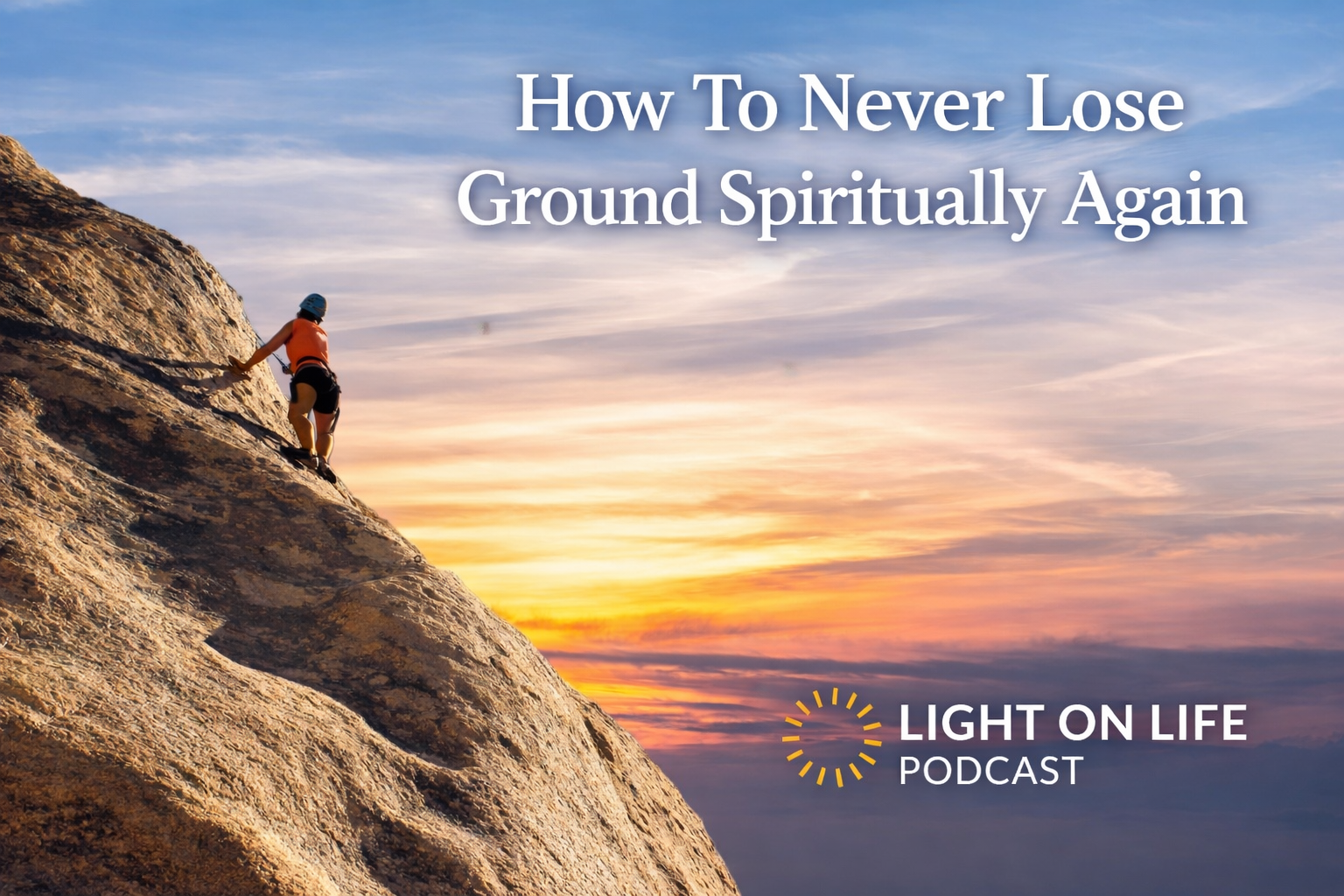
To climb the mountain of spiritual growth requires faith in God’s ability to keep you moving upwards. In this Light on Life teaching, we explore Jude 24 and uncover God’s promise of a steady, no-slip, sure-footed walk in His ways. This passage in Jude 24 isn’t about repenting after you fall. It’s about something way more dynamic that’s available to you as a child of His. This passage is about God’s ability to keep you from falling in the first place. You will see from the Word of God that Scripture shows that God lights your path, secures your steps, and guards your footing as you walk the Jesus life. If you are tired of slipping spiritually, then this message is for you. You can regain lost ground in the Name of the Lord. You can choose a no-slip, Jesus is Lord life, by faith in God. How to Never Lose Ground Spiritually, that’s our focus on this week’s Light on Life.
Listen to the Audio
This Week: God is able to keep you from stumbling; you can regain lost ground and stay steadily increasing in Him once and for all.
#S13-005
Never Miss an Episode
Join believers who are growing in God’s Word every week. Subscribe to the Light on Life Podcast on your favorite platform:
Use this if your podcast app supports adding shows by RSS feed.
Accept the Challenge
Decide — Take Back — Steady.
Decide today to use your faith and place it squarely on God’s ability to keep you—not your ability to keep yourself.
Take back the ground you’ve lost by getting back in motion with the Word. Refuse passivity and step forward with confidence, knowing that God strengthens those who lean on Him.
You don’t have to slip again—God can make your steps secure and keep you steady.
Psalm 18:30–33 (ESV) — This God—his way is perfect; the word of the LORD proves true; he is a shield for all those who take refuge in him. For who is God, but the LORD? And who is a rock, except our God?— the God who equipped me with strength and made my way blameless. He made my feet like the feet of a deer and set me secure on the heights.
Join the Conversation
Each week's podcast also contains a question designed to encourage testimony. Testimony is vital to a believers life. We overcome by it (Rev. 12:11).
This week's question:
Question:
How does knowing that God keeps your feet from slipping change the way you think about your walk with Him?
Share:
What is one way you’re choosing to walk forward this week, trusting God to keep you sure-footed?
Remember:
You’re not alone—God is able to keep you from stumbling, as we grow stronger together.

About Emery and Sharon
For nearly five decades, Emery has devoted his life to helping people grow in Christ through the power of the Word and the leading of the Holy Spirit.
Together with his wife, Sharon — his partner in life and ministry for 44 years — he equipped believers to live Spirit-filled, practical lives of faith.
At the heart of the mission is this: helping believers apply God's words so faith becomes active and unstoppable.
If this episode helped you, would you share it with a friend and leave a quick review?
Podcast Notes:
Well again, welcome.
Let’s pray.
Father God, thank you for your Word and the leading of your Spirit. Thank you for showing us how not to lose ground spiritually in you. It’s right here in your Word, plain as day — you’ve set this aside for your children. I give you the praise and glory for these truths in Jesus’ Name, Amen.
Not Losing Ground Spiritually: Review of Prayer Aspect of the Book of Jude
So, we have been on Jude 20 for the past four podcasts casting a vision for the prayer life.
Jude 20 (ESV) — 20 But you, beloved, building yourselves up in your most holy faith and praying in the Holy Spirit,
Building yourself up.
Spiritual growth or increase is the result of building yourself up.
We said that it’s like rock climbing — like a mountain climber scaling a steep cliff face.
As a climber, as a person who desires increase in their spiritual life, you cannot wish your way upward.
It doesn’t work.
Growth doesn’t come by wishing — it comes by applying.
You must reach for the next section of rock overhead, get a firm grip on that piece and drive the pegs into the rock.
Every anchor point is something solid that helps you rise.
At the same time, you’ve seen a mountain climber who has slipped and slid back down the mountain.
Hebrews 2:1 points its finger at this very thing.
Hebrews 2:1 (ESV) — 1 Therefore we must pay much closer attention to what we have heard, lest we drift away from it.
Some of God’s people have slipped down the slope and lost valuable ground.
I want to challenge you today to take back the ground you lost.
And then, receive this next challenge as your supreme goal to never lose ground again.
Now, how exactly can we attain a no-slip life?
Building a Profitable Word Life: Pegs to Build a Profitable Word Life
So, we’re making the climb.
We’re go upward — we are pressing for the mark.
But we need some Word of God to help make the climb.
We have that Word in Jude 24.
Losing Ground Spiritually: Never Again
Let’s start with verse twenty-one.
Jude 21–24 (ESV) — 21 keep yourselves in the love of God, waiting for the mercy of our Lord Jesus Christ that leads to eternal life. 22 And have mercy on those who doubt; 23 save others by snatching them out of the fire; to others show mercy with fear, hating even the garment stained by the flesh. 24 Now to him who is able to keep you from stumbling and to present you blameless before the presence of his glory with great joy,
As we get ready to close the book of Jude podcast-wise, this is the twelfth podcast in this series, we are left with several closing admonitions.
Keep yourself in the love of God.
Wait for the mercy of our Lord Jesus Christ that leads to eternal life.
Save others and show mercy with fear.
And you may think, ‘Wow, just what I need — another list of things to do.’
If you think that way, this podcast is for you.
Keep yourself in the love of God — how do I keep from slipping?
Wait for mercy — how do I stay engaged here?
Save and show mercy without fear — How, how, how do I hang here?
Well, in these verses lies the secret.
And I say secret because it’s not apparent to everyone — it wasn’t to me — on how to not lose ground spiritually in any of the areas that Jude lists to close this letter out.
Are you up and down in your spiritual experience?
Is your Church life up and down?
Is your prayer life up, and down — hot and cold?
What about your Bible reading — does it follow the same trend where you gain ground in God but it seems to slip out of your grasp?
I used to press and push and fast and pray and grew some but I would get pulled off my growth track by distractions.
But, the Lord led me to the secret right here in this short book of Jude.
And when I found it I said these words, ‘I will never lose ground again.’
You can do the same.
So, grasp these words.
24 Now to him who is able to keep you from stumbling…
The Greek word ‘stumbling’ is the one we want to look at and with that thought, here is the Definition of the Day.
Now, can I encourage you to write this definition down?
Can I admonish you to write these scriptures down in your journal?
If you are driving in your car or you are in a place where your hands are otherwise engaged and cannot write, the notes to this podcast are available at emeryhorvath.com.
The word ‘stumbling,’ used in the ESV, means not walking unsteadily — or in other words — God is able to keep you steady.
Not ‘stumbling’ also means walking with greater precision.
This is only place in the New Testament where this word is used.
What Jude is writing here carries the sense of not losing footing while you are in motion.
Among ancient Greeks the word ‘stumbling’ was used to describe a sure-footed horse who does not stumble.
The horse was in motion.
It carries the sense of a runner who stumbles.
Again, the runner is in motion — he’s headed up the track.
Have you ever seen a sprinter at the Olympics fall?
The word ‘stumbling’ carries the sense of a traveler who trips on uneven ground, or a soldier who loses footing in a battle.
Still others have applied the word to a morally upright person who does not lapse in his morality.[3. James Shaddix and Daniel L. Akin, Exalting Jesus in 2 Peter, Jude (Nashville, TN: Holman Reference, 2018).]
In all of these cases, there is motion — the person is moving.
The individual is reaching.
He is trying to go higher — he is walking up the road.
He is running up the road.
To stumble, you have to be moving.
If you’re not moving, if you’re stuck — if you are where your spiritual life is stagnant, let’s get that settled right now.
Reach out to the Lord, right now.
He is right where you left Him.
Point your heart to God and say, “Lord, I repent. Thank you for the Blood of Jesus that cleanses me. I am headed back up the path of righteousness.”
Once, you pray this prayer, then get in motion.
Head on out and with your heart in agreement say this:
I am heading out and I will never lose ground again. I will never stumble because God is able to keep me from stumbling.
This metaphor of not stumbling is significant only because someone already is walking or running.[1. Earl D. Radmacher, Ronald Barclay Allen, and H. Wayne House, Nelson’s New Illustrated Bible Commentary (Nashville: T. Nelson Publishers, 1999), 1730]
Now, make certain that you get this.
This word ‘stumbling’ is not helping someone recover after they have fallen.
God is able to keep you from falling in the first place.
This is sure-footedness on the path God has called you to walk.
‘Now to him who is able to keep you from stumbling’ is preventative language.
It is not just forgiveness after failure.
Jude is not saying here that “God will pick you up after you fall.”
Now, that’s absolutely true but that’s not what is going on here in Jude 24.
There are other Bible passages that speak of forgiveness when you have fallen.
1 John 1:9 for example.
**1 John 1:9 (ESV) — 9 If we confess our sins, he is faithful and just to forgive us our sins and to cleanse us from all unrighteousness.
Now, people, because they are sin-conscious and not righteousness conscious, think, ‘Well, you sin everyday.’
Here is this sin consciousness identified in God’s Word.
Hebrews 10:1–2 (ESV) — 1 For since the law has but a shadow of the good things to come instead of the true form of these realities, it can never, by the same sacrifices that are continually offered every year, make perfect those who draw near. 2 Otherwise, would they not have ceased to be offered, since the worshipers, having once been cleansed, would no longer have any consciousness of sins?
If you read this close, perfection or spiritual maturity or spiritual growth, take your pick, comes when a person doesn’t have a consciousness of sin.
That is, the sacrifice of Jesus, which redeemed them from the Law, is absolutely real to them and they are walking in the light of that.
If you are of this mindset, that is you are always conscious of your sins, conscious of your failures, conscious of your faults — you’re always talking about them — this state exists because you are looking in the wrong place.
Look at Jude 24.
Quit looking at yourself.
God is able to keep you from stumbling in the first place and, He can guard your steps before collapse ever happens.
Are you trusting Him in this area?
That’s the key — looking to Him is the key.
Your faith should be in God’s ability to keep you from falling not in your ability to do better at keeping yourself from messing up.
Have faith in God’s ability to keep you — not your ability to keep yourself.
God is watching over you.
He is watching over your steps.
The Lord will alert you in your spirit when you are getting ready to miss it.
If you heed that, you won’t miss it.
Yes, it is possible to not sin every day of your life.
It is not as some have reported.
Not Losing Ground Spiritually: Psalms 18
Now in case you are not convinced, let’s do a scripture walk and see what the Word says.
Of course, you have this verse in Jude 24.
Go to Psalm 18.
Psalm 18:30 (ESV) — 30 This God—his way is perfect; the word of the LORD proves true; he is a shield for all those who take refuge in him.
This God His way is perfect.
His way is the path that He walks on.
The Hebrew word ‘way’ is the word ‘derek’ and it means to proceed or walk with the feet.[2. Finis Jennings Dake, The Dake Annotated Reference Bible (Dake Publishing, 1997)]
It’s a word picture that points to the act of walking or going, and the figurative sense of living and acting in a certain manner.
God’s way is always the right way.
It is the way of purity — for only the pure in heart shall see God.
It’s the way of honesty — God cannot lie.
It’s the way of faith — without faith, it’s impossible to please Him.
It’s the way of compassion — for God so loved the world.
The phrase “His way is perfect” means God’s way is absolutely flawless.
You understand, perfect.
You understand, no flaws in His counsel. — zero, zip, nothing — just perfect.
His way is totally trustworthy and dependable.
This isn’t describing an instruction manual, but rather affirming that everything God does—his decisions, actions, and governance—demonstrates absolute integrity and consistency.
How different is God’s way’s than man’s — my thoughts are not your thoughts — my ways not your ways is true.
God’s perfect way compared to man’s way’s imperfect, uncertain and completely fallible way — let me tell you, there is a Grand Canyon gulf of difference.
Now, keep reading Psalms 18.
Psalm 18:31 (ESV) — 31 For who is God, but the LORD? And who is a rock, except our God?—
That’s verse 31 — now verse 32 — listen to it closely.
Psalm 18:32 (ESV) —32 the God who equipped me with strength and made my way blameless. 33 He made my feet like the feet of a deer and set me secure on the heights.
Now, reread verse 32 in the light of verse 30
This God— the God whose way is perfect, equipped me with strength AND…
And what?
AND made my way blameless.
What does the word ‘way’ mean? — To walk with the feet.
What does the Hebrew word ‘blameless’ mean?
I’m glad you asked.
The word ‘blameless’ is the same word perfect used of God’s way in verse 30.
God whose way is perfect.
God, who made my way perfect.
In other words, God will take His way and make it your way.
The word ‘blameless’ means complete, unscathed, without fault, free of blemish, impeccable, honest, and devout.
If you walk with Him — if you exercise your faith in Him — He will make your way like His way.
God never slips and He never falls and you don’t have to either.
You do not have to be a screw-up going somewhere to happen.
Are you excited about that?
If you are, look at verse thirty-three.
He [the God who made MY WAY perfect,] made my feet like the feet of a deer and set me secure on the heights.
‘Set secure’ is one word in the Hebrew and it means to stand, to remain standing, to bring to a halt, and sit in position.
It means the ability to maintain footing on difficult terrain.
It means making your footing sticky so you don’t slip.
The word is causative meaning God does it!
So, deer have agility and jumping ability that mountain goats don’t have.
Mountain goats have sticky feet — they are born with it — their hooves are made to not slip.
With this in mind — listen to this verse again.
He [the God who made MY WAY perfect,] made my feet like the feet of a deer and set me secure on the heights.
He made your feet swift and agile like a deer and [to these same feet] God added the stickiness of a mountain goat so that while we are jumping on the path — the way — you will be set secure so you won’t slip.
This ‘sticky-feet’ ability is not something you are not born with.
No, God adds it to your life when you believe Him to keep you from falling.
I’m telling you — you don’t have to lose ground.
Drop down now and read verse thirty-six of Psalms 18.
Psalm 18:36 (ESV) — 36 You gave a wide place for my steps under me, and my feet did not slip.
Not Losing Ground Spiritually: Scripture Walk in Psalms
Now, for a thing to be established in God takes more than one witness.
I have already given you two.
Let’s do a scripture walk through Psalms and see this same ’sticky-foot’ not slipping principle that we see in Jude 24 — now to Him who is able to keep you from falling.
Psalm 17:5 (ESV) — 5 My steps have held fast to your paths; my feet have not slipped.
Psalms 31:8 (ESV) — 8 and you have not delivered me into the hand of the enemy; you have set my feet in a broad place.
A broad place is a spacious peaceful place full of liberty.
Now, listen to these next three verses and, when you do, listen for your ‘no-slip’ life in God
Psalm 40:2 (ESV) — 2 He drew me up from the pit of destruction, out of the miry bog, [that’s your life before you met Jesus — you were on your way to destruction] and set my feet upon a rock, making my steps secure.
Psalm 56:13 (ESV) — 13 For you have delivered my soul from death, yes, my feet from falling, [again — that’s your life before you met Jesus — you were on your way to eternal death] that I may walk before God in the light of life.
Psalm 116:8 (ESV) — 8 For you have delivered my soul from death, [that’s your life before you met Jesus — you were on your way to eternal death] my eyes from tears, my feet from stumbling;
So, did you hear the testimony of your life here?
You were lost but God saved you from death and set your feet secure in His way.
Now, you are walking in His way.
Your confidence is in His ability to keep from falling from His way.
And now, His Word comes to light the way.
Psalm 119:105 (ESV) — 105 Your word is a lamp to my feet and a light to my path.
Notice that both the feet and the path are illuminated.
Have you ever been on a dimly lit street?
A path that doesn’t have enough light?
And with that thought, here is the Historical Background of the Day.
Not Losing Ground Spiritually: A Dimly Lit Street vs. a Brightly Lit Street
In ancient Greece and Rome, oil lamps were among the first forms of street lighting.
These oil lamps provided a moderate flame, which was effective for basic illumination and security.
The lamps required regular maintenance, including refilling with oil and cleaning, which was typically managed by lamplighters.
These lights produced by oil lamps was often dim and inconsistent, leading to poorly lit streets.
They were susceptible to weather conditions; rain or wind could extinguish the flame.
The need for manual operation meant that lamps were not always lit at the necessary times, especially in the early evening or during inclement weather.
Seventeen centuries later, things hadn’t changed much.
Most cities were lit at night by oil lamps using whale oil.
These oil lamps were typically placed on posts about ten feet high and spaced approximately fifty feet apart.
They were poorly maintained and provided limited light for city streets.
These oil lamps often created pools of yellowish light with dark areas in between.
Bad stuff happened in the dark areas.
Walking in the dark areas was dangerous.
Shadows concealed trip hazards.
Criminals lurked in the darkness waiting for an opportunity to do evil.
People traveled fearfully and without the confidence of knowing where to place their next step.
Then came a revelation that produced a revolution!
Electric streetlights were installed in cities by the late 1800s.
The difference was dramatic.
Obstacles became visible.
When the darkness dissipated, the criminal element went with it.
People began to walk with more confidence.
It was the same city — the same streets — the same houses — the same people.
Nothing changed except the light.
Now let’s upload Psalm 119:105 to the 21st century.
Your Word is an LED lamp unto my feet and an LED light to my path.
Fully illuminated.
Isaiah 30:21 (ESV) — 21 And your ears shall hear a word behind you, saying, “This is the way, walk in it,” when you turn to the right or when you turn to the left.
Go up now to verse fifty-nine in Psalm 119.
Psalms 119:59 (ESV) — 59 When I think on my ways, I turn my feet to your testimonies;
What’s the Psalmist saying here?
Pull this forward into the New Testament and put it altogether.
Romans 8:14 (ESV) — 14 For all who are led by the Spirit of God are sons of God.
And now verse sixteen.
Romans 8:16 (ESV) — 16 The Spirit himself bears witness with our spirit that we are children of God,
So, you’re walking the Jesus road, God’s path — God’s ways and you reach for something and the buzzer goes off inside you.
You get a check in your spirit.
What is a check in your spirit?
It is the Holy Spirit keeping your feet on the path of God’s way.
Now, the Psalmist David was speaking out of the Old Covenant when he said, I thought on my ways and I made a decision to turn my feet into your testimonies — into your Word.
Can I tell you that this looks a little different for the child of God — for the Jesus follower of the New Testament.
As a child of God, you should have already made a decision to ‘Do the Word’ and ‘to obey the voice of your spirit.’
You should have already made a decision that says ‘not my will but yours be done.’
You could say it this way ‘not my ways but your ways be done.’
It’s good to reaffirm your consecration to God.
If you haven’t yet made these choices — that’s what Jesus is Lord means.
Get on this.
Not my will, not my way — your way — your path — that’s my choice.
Forget about your ways — Say ’no way to your ways.’
Turn your feet to His way — to His testimonies!
And then verse one-hundred—one says.
Psalms 119:101 (ESV) — 101 I hold back my feet from every evil way, in order to keep your word.
Not Losing Ground Spiritually: Your Blameless Destiny
Let’s close with this.
Jude 24a (ESV) — 24a Now to him who is able to keep you from stumbling…
Now listen for this next big word AND.
If a no-slip life wasn’t enough — there’s an AND.
Jude 24b (ESV) — 24b and to present you blameless before the presence of his glory with great joy,
The Greek word ‘blameless’ means unblemished, without fault, perfect.
Wow!
That’s what Jesus did.
This is what the Blood of Jesus accomplished — wiped your sins away like they never existed.
Blameless — that’s who are.
That’s how you are going to be presented to the Father in glory.
It’s going to be a happy day.
Not Losing Ground Spiritually: Putting the Word Into Action
So what have we learned today?
We learned that it’s possible to live a ‘no-slip life.’
By trusting God to make your feet sticky, you can live a life of continual ascent in the things of God.
Starting and stopping is now of the past.
That’s behind us.
We are in full trust mode.
He knows the path that I take because it’s His path.
So my way is certain and sure.
In the Light of this:
Move towards God in repentance, if you have lost ground.
Get up and walk God’s path for your life. He is right where you left Him.
Place your faith in God’s ability to keep you rather than in your ability to “do better the next time.”
Declare with your mouth I will never lose ground again. Let your confession of God’s Word light the way.
Meditate on the Word so that His Word becomes an LED light to your feet.
If this podcast has helped you today, consider sharing it with someone who needs the encouragement to live a life free from stumbling.
Now Father God, thank you for this life-changing Word of God, How it thrills the heart to know that we are going from glory to glory and from grace to grace. We love you Father and we give you all our devotion in Jesus’ Name, Amen.
How to Never Lose Ground Spiritually Again.
You guys have a great God-week and we will see you next time for another edition of Light on Life.
🎧 Never Miss an Episode
📩 Get Weekly Study Tools
Join the mailing list for new episodes, guides, and resources every Tuesday at 2:00 AM CST.
Subscribe by Email →🎧 Suggested Episode
If you found this teaching on not stumbling in the things of God helpful, check out “The Secret to Prophecy” — it builds on today’s lesson.
Listen Now →